

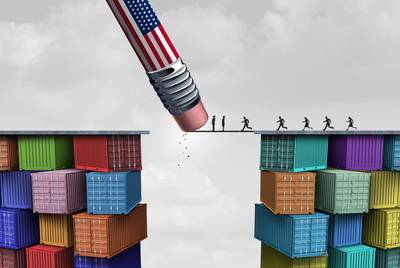
Earlier this year, The U.S. Department of State, the U.S. Department of the Treasury’s Office of Foreign Assets Control (OFAC), and the U.S. Coast Guard issued a new advisory to provide those engaged or involved in trade in the maritime industry with further information and tools to counter illicit shipping and sanctions evasion.
The advisory is representative of the U.S. Government’s increasingly detailed efforts towards addressing these issues, as illustrated by OFAC’s recent sanctions actions which show a trend of incremental but clear extension of oversight. For example, new sanctions imposed in June this year against the Islamic Republic of Iran Shipping Lines and its Shanghai-based subsidiary E-Sail Shipping went into effect, impacting previously exempt humanitarian activities.
The challenge however is that with the sanctions, fraud and money laundering landscape becoming more complex, more organizations are being held to account for trying to stop them from happening, which includes businesses that may not have previously maintain ed rigorous due diligence and compliance programs.
What then does this new advisory tell us, and how does the full shipping supply chain need to respond?
What’s new in the 2020 advisory?
Over the past few years OFAC has released five advisories regarding the maritime industry, each one further defining and alerting the industry to the varied deceptive shipping practices used to evade sanctions. The intention? To provide those that utilize the maritime industry for trade with information, red flags and tools to counter current and emerging trends in sanctions evasion related to shipping and associated services.
Previous advisories have varied widely in focus. The 2018 advisories focused primarily on the North Korea and Syrian trade and sanctions compliance, targeting prevalent tactics in the region, such as falsifying information, physically altering ship registrations, ship to ship transfers and disabling AIS transponders; all of which still apply as key issues.
This year’s advisory was however both broader and more detailed, looking at comprehensive supply chain due diligence and Know Your Customer (KYC) counterparties (things financial institutions have been doing for 20 years), but also offering guidance to the full gamut of those involved with the shipping industry including insurers, flag registry and port control.
Importantly, what the most recent advisory has done, other than upping the ante significantly for all parties in the supply chain when it comes to monitoring sanctions compliance, is signal a shift in position for OFAC. What seems apparent is that OFAC’s focus is now to collaborate with industry participants by providing them with more prescriptive guidance to combat illicit activity. This shift towards a private-public partnership is a long way from the relationship of 10-15 years ago, in which OFAC seemed to approach the challenge with adversarial oversight rather than collaboration.
 © Feng Yu/AdobeStockMeeting the challenge
While the intention to have all organizations on the shipping supply chain involved in the compliance and due diligence process, widening the net in this way has created an environment in which organizations such as port authorities, logistics companies, and freight forwarders are subject to a much higher standard of due diligence than they are used to.
These issues are complex, even for financial institutions that are used to this level of compliance. Trade finance is one of the areas that requires a robust due diligence and screening process, in order to detect potential sanctions risks. However, trade compliance screening comes with a number of complexities, including:
- Trade finance transactions often involve a large number of counterparties that all need to undergo KYC checks;
- Much of the data and documentation used in trade finance is still paper-based or in an unstructured format, making it difficult to digitalize the process;
- There are numerous international reference lists to manage to ensure the screening process is as accurate and up to date as possible.
This is just one side of the coin. When you look at the rapidly moving sanctions landscape, operating to this standard of compliance is going to very quickly become overwhelming for many.
Moreover, OFAC doesn’t have all the answers as keeping track of changes (even between advisories) manually can be challenging. For instance, the vessel named “SAM MA 2” that was listed on the 2018 OFAC advisory has since changed its name to “MYONG SIN” and was listed on the 2019 advisory.
By waiting for new advisory notices to come out, organizations can become exposed to the potential risks that occur in real time. In order to protect their business and its reputation, it is important for them to be proactive in spotting red flags themselves.
A further example is that a vessel named “ASIA HONOR” was not listed on the February 2018 advisory, even though it had visited the port of Najin, North Korea on June 23rd, 2017 – something that could have been verified through wider networks and tracking.
A new approach
For companies new to enhanced due diligence and compliance, these challenges are daunting. First and foremost, internalizing and institutionalizing sanctions compliance is key. This means operating a robust compliance function and having someone responsible for consistent monitoring, evaluation and implementation of a compliance program. This will be the first step towards meeting all the guidelines in the current advisory.
However, operating this function relies on information, and it can’t be done manually given the vast network of shipping routes, ports, ships, and other business in the network.
Outsourcing this intel, and the technology needed to monitor and identify red flags is likely to be the most cost-effective way of doing that. Sophisticated trade compliance software can spot such activity and alert the organization to the risk, even if the regulator does not.
Some of the risk patterns OFAC has called out suggests that a more prudent approach to identifying risks related to trade is needed. This goes beyond the complex due diligence that must be conducted prior to agreeing to finance a transaction, and requires ongoing vigilance to identify other red flags, such as when a ship approaches a sanctioned or high-risk port or when they turn off their AIS tracker.
The future
Ultimately the goal of OFAC’s advisory is to work towards the elimination of money laundering and fraud, but this will require everyone in the trade supply chain to operate with the same, or near same, due diligence that has been expected of the financial institutions financing the trade.
This will be a big change for many, but as with most risks, they are manageable with the right combination of information, insight, and application. Shipping organizations should rightly take a moment to assess their position, but while the new advisory clearly shows OFAC’s increased scope in enforcing compliance, it also helps lay the route map to success for the organizations most impacted.

The Author: Dave Loeser is Senior Director of Product Strategy for Accuity. He has guided the success of the Firco portfolio of financial crime screening solutions for more than a decade and is currently focused on cross-product strategic initiatives.